
Young people and employers will be partners in shaping the plan, not consultees brought in after the important decisions have been made. Rt Hon Alan Milburn, From a Welfare State to a Working State, para 866
That sentence is about the local plans every area of England would have to write for getting young people into work or learning. It’s the strongest thing the report says about youth voice, and it’s why we wanted to look more closely.
Alan Milburn’s final report on young people and work, From a Welfare State to a Working State, came out this month. It’s long, and most of the coverage so far has been about welfare, employers and money.
This isn’t a full review. We wanted to know one thing: where do young people get a say? So we ran some word searches across the main text, read the passages they turned up, and pulled together the figures and summaries below. If we’ve missed something, please tell us.
The report in brief
The headline aim is to cut the share of young people who are not in education, employment or training (NEET) from about one in eight to around 5% by 2036. The main proposals are:
- a legal guarantee of opportunity and support for every young person
- a Youth Opportunity Service (YOS) in every part of England by 2029, giving each young person who needs it a named adviser and a Participation Plan
- mayors and strategic authorities taking charge of the system for 16 to 24 year-olds, through an Area Youth Participation Plan
- a separate benefits system for under-25s.
These are recommendations to government. None of it is policy yet.
Young people were asked
The review did go and talk to young people. Nearly 3,000 answered its survey, two thirds of them NEET, and it ran a Youth Panel and workshops with disabled young people. Chapter 2 leans heavily on what they said, and some of the best lines in the report are theirs.
Does anyone else ever feel like they are part of a process rather than a person? Participant in workshops with disabled young people, quoted on p. 193
The 45% figure
This was the number that stood out most to us.
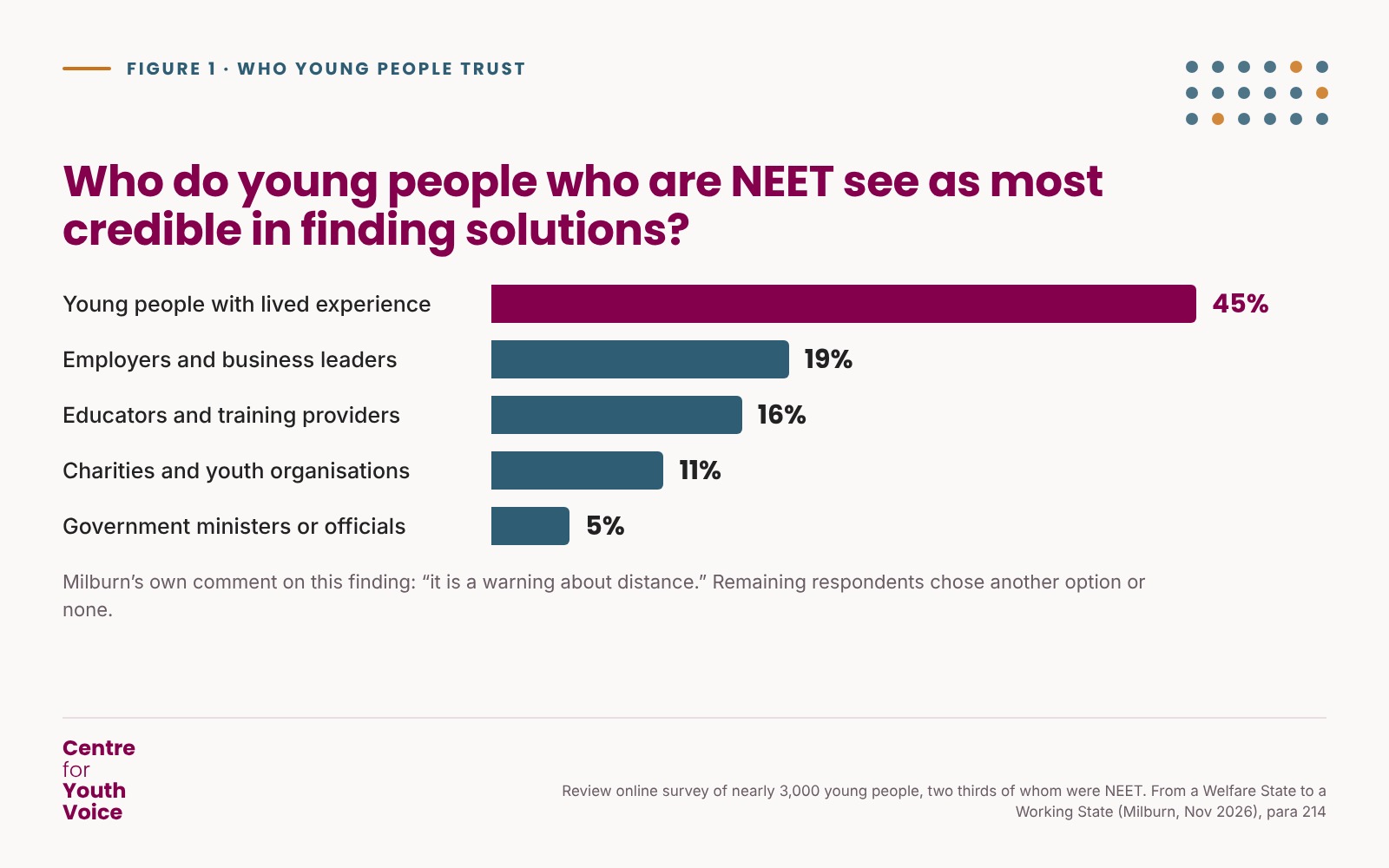
The review’s survey asked young people who they see as most credible in finding solutions. Among those who were NEET:
- 45% chose young people with lived experience
- 19% chose employers and business leaders
- 16% chose educators and training providers
- 11% chose charities and youth organisations
- 5% chose government ministers or officials.
So young people with lived experience were picked more than twice as often as any other group, and nine times as often as government. Milburn’s own reading is that it is “a warning about distance”: young people don’t necessarily believe the institutions talking about them understand what it feels like to be them.
We think it matters for three reasons.
First, it comes from the review’s own survey. Nobody in the youth sector had to make the argument. Young people who are out of work and education said it themselves, to a government review.
Second, it’s a practical point as much as a principled one. The whole plan depends on young people walking through the door of a new service and trusting what they find there. If the people they trust most are others who have been through it, then peer researchers, peer mentors and young people in governance are a sensible way to build that trust.
Third, it applies to us too. Only 11% chose charities and youth organisations. Those of us who work in the sector can’t assume we speak for young people, any more than a mayor or a minister can.
What the word counts show
We searched the main text (the foreword and chapters 1 to 9, roughly 103,000 words) for the terms people in our field tend to use.
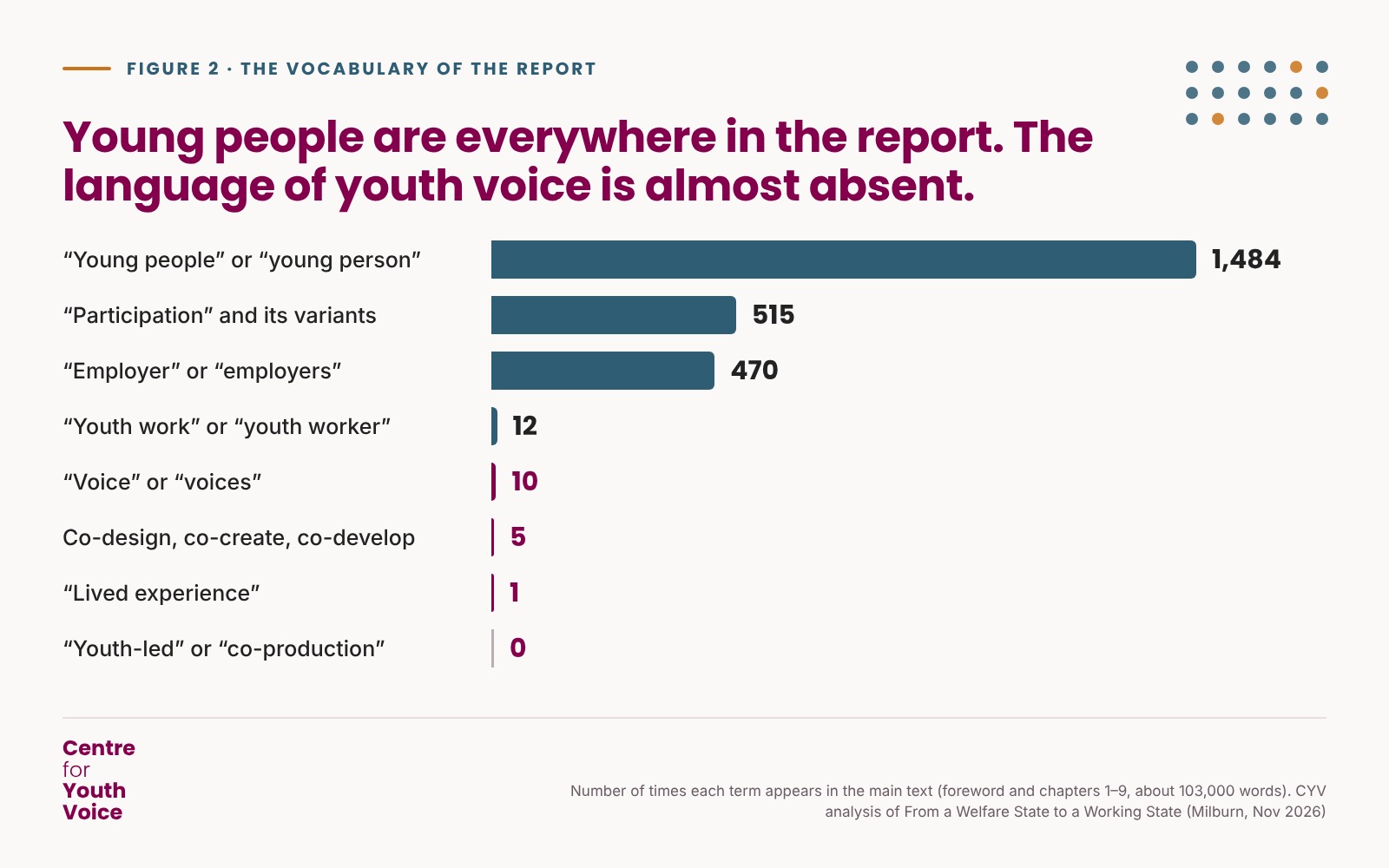
Young people come up 1,484 times and employers 470 times. “Co-design”, “co-create” and “co-develop” come up five times between them, and “lived experience” once. We couldn’t find “co-production” or “youth-led” anywhere.
“Youth voice” does appear, seven times, but each one is the title of Youth Employment UK’s Youth Voice Census, which the report uses as evidence.
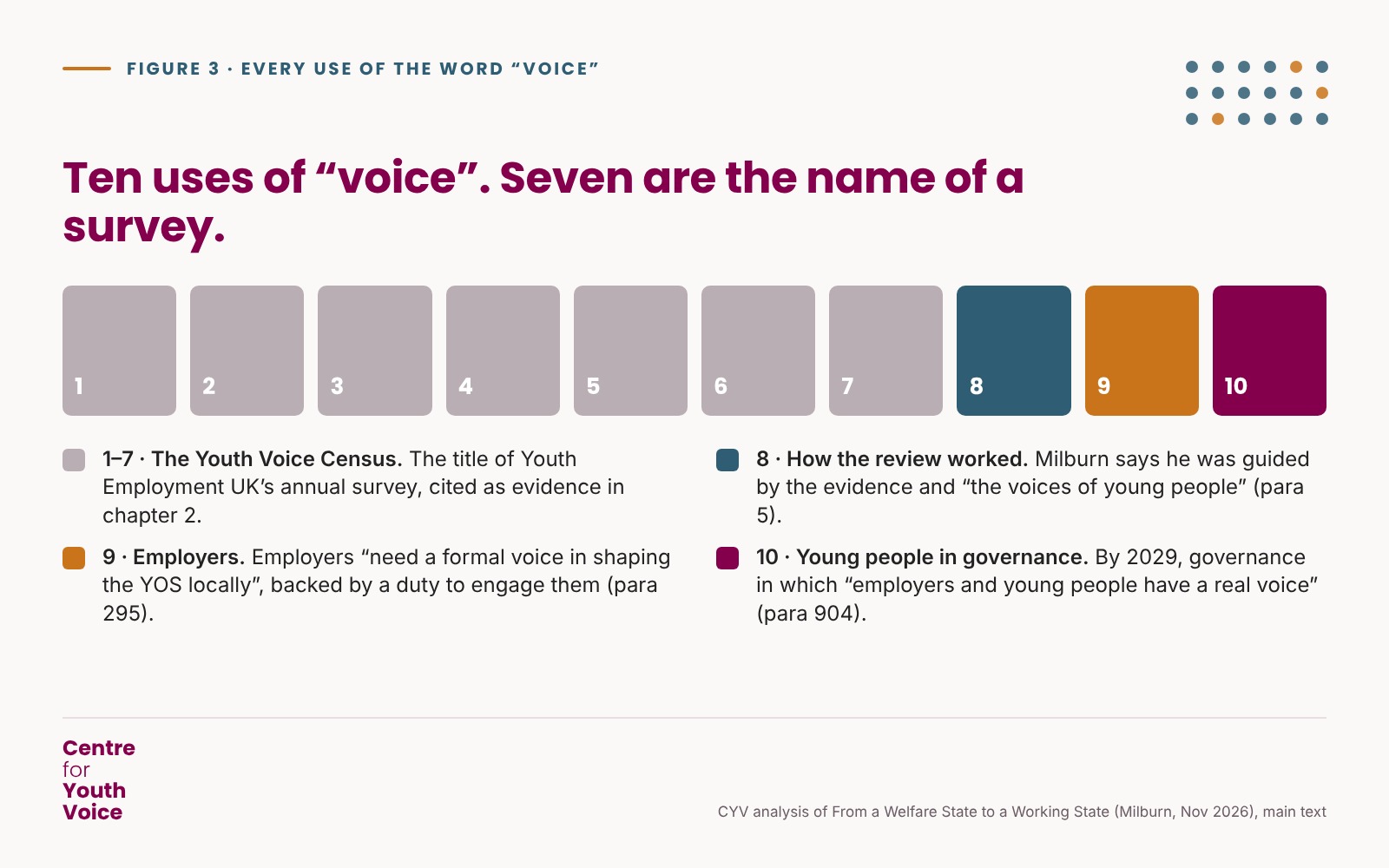
Of the other three uses of “voice”, one is Milburn saying he was guided by “the voices of young people”. One says employers “need a formal voice in shaping the YOS locally”, and that comes with a proposed duty on strategic authorities to engage them. The last says that by 2029 every area should have governance in which “employers and young people have a real voice”. We didn’t see a matching duty for young people.
We also looked at phrases ending in “-led”. “Locally led” or “mayor-led” came up 13 times, “employer-led” five times and “industry-led” twice. Young people are mentioned 1,484 times, but “youth-led” didn’t come up once.
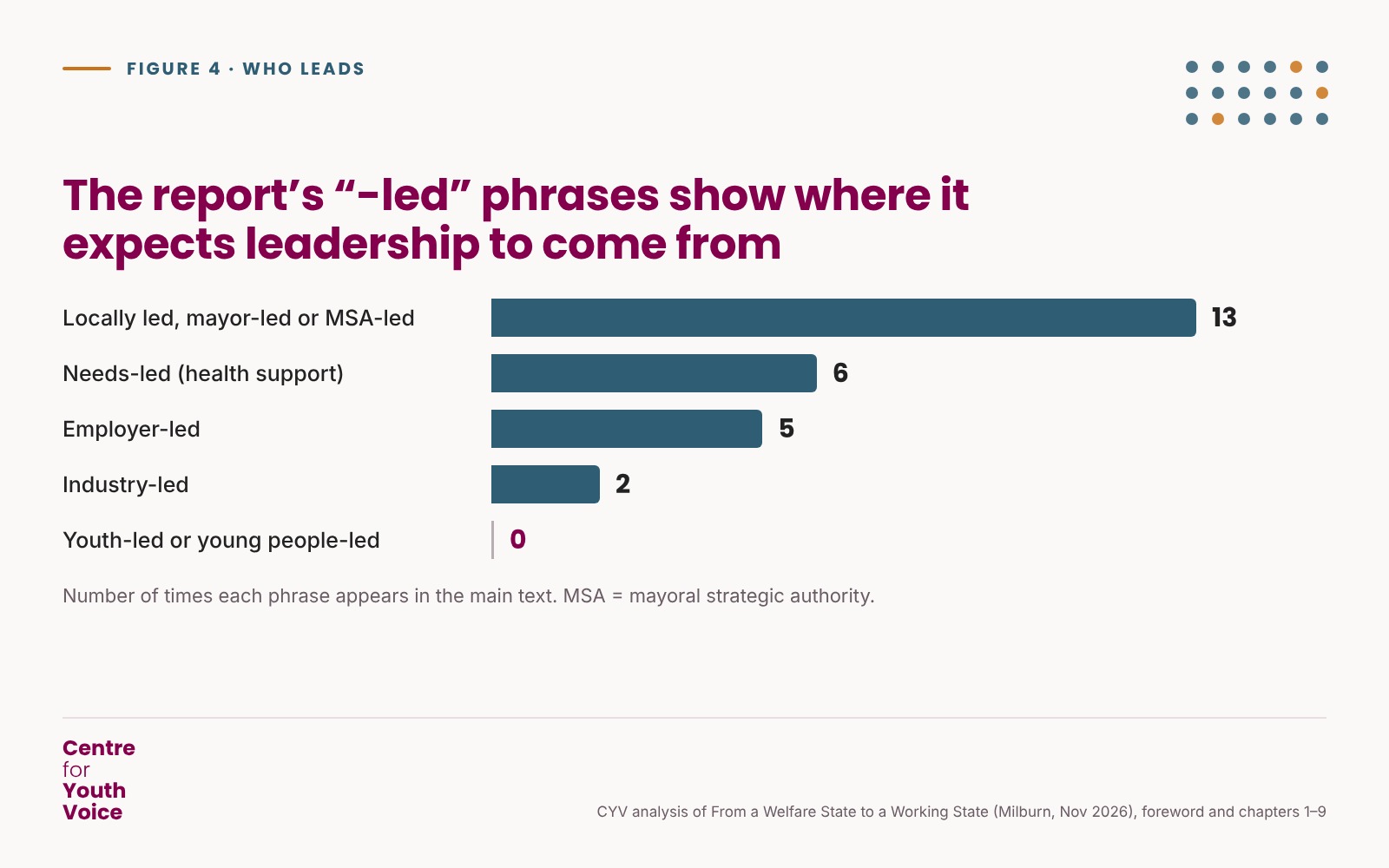
Counting words is a blunt tool and it won’t catch everything. It does give a rough sense of where the report’s attention is.
“Participation” means something else here
The word “participation” and its variants appear 515 times, and “youth participation” 85 times. In the uses we looked at, it means being in education, training or work. We didn’t find it used to mean having a say in decisions. Put bluntly: 85 uses of “youth participation”, and none that we could find about voice.
That could get confusing. A lot of us use “youth participation” to mean young people’s right to be heard. If these proposals go ahead, the same phrase will be in the name of every local plan and a set of national measures, meaning something different. It’s probably worth being clear in meetings which one you mean.
The commitments we found
We found six places where the report says young people should have some influence. There may be others.
| What the report says | Where | What isn’t spelled out |
|---|---|---|
| Each young person “co-develops” their own Participation Plan and co-signs it | Paras 105, 712 | The plan comes with a duty to engage, and benefit can be lost as a last resort |
| The YOS’s physical and digital services should be “designed with young people” | Para 841 | Who does this, when, and what it’s paid for from |
| Area Youth Participation Plans will be “co-created” with young people, who are “partners in shaping the plan, not consultees brought in after the important decisions have been made” | Para 866 | What counts as co-creation |
| Young people and practitioners should help design how the new shared data system handles transparency, access and challenge | Para 894 | How |
| The leader of each local service needs the confidence of “young people themselves” | Para 849 | How anyone would know |
| By 2029 every area should show governance in which “employers and young people have a real voice” | Para 904 | What “real” means |
If you only remember three, make it these: co-create the local plan with young people, design the service with them, and give them a real voice in how it’s run by 2029.
What we couldn’t find
In the sections we looked at, there wasn’t much on how any of this would happen. We didn’t see a named structure for involving young people, such as a youth board or panel. We didn’t see money set aside for it in the costings. And the measures of success seem to be about whether young people get into learning or work and stay there, with nothing we could find on whether they shaped the plan or trust the service.
One other thing gave us pause. Young people on benefits would have a duty to engage with their plan, and could in the end lose their Youth Allowance if they persistently refuse. The report says sanctions should be rare and a last resort. Even so, co-signing a plan when your income depends on it isn’t quite what most of us mean by co-production.
On youth work
The report is positive about youth work. It says cuts have “hollowed out” support, backs the Youth Matters strategy and the 1,000 youth workers DCMS has committed to fund, and asks for more specialist youth workers in areas with high NEET rates. It also says “consideration should be given to building statutory entitlements for youth provision”. Youth work and youth services are named as having a key role in how each local service reaches young people.
Timings
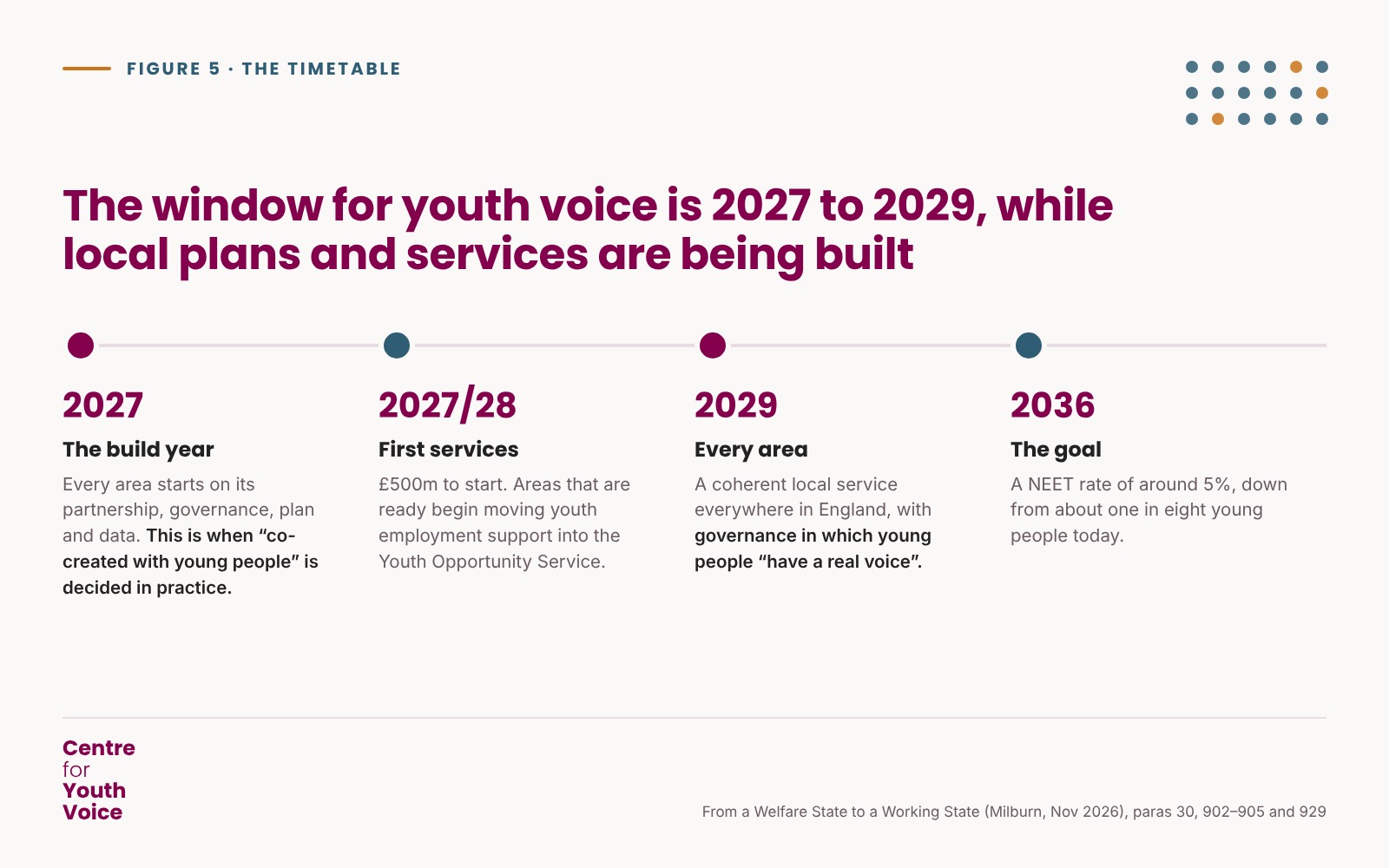
If government takes this up, 2027 is when areas would start building their partnerships and plans, with every area expected to have a service running by 2029. So the next year or two looks like the time to be in those conversations.
A few thoughts for practitioners
- Find out who in your strategic authority or council would lead on an Area Youth Participation Plan, and ask early how young people will be involved.
- The 45% figure is good evidence for peer research, peer-led design and young people in governance.
- Plans are meant to draw on local intelligence about why routes are breaking down and what young people want to move towards. Peer research is one way of getting that.
- Each plan would need sections on disabled young people, on care-experienced young people, young carers and young parents, and on those facing several disadvantages at once. If you work with these groups, you have something a new system will need.
- Ask how your area will know whether young people actually had influence.
How we can help
Our next Community of Practice sessions are on youth voice in local authorities (January) and with care-experienced young people (March). The Resource Library has practical toolkits on co-design, peer research and governance, the Evidence Library has more than 320 reports, and the Co-Assessment Tool lets you check your own practice.
If you’re working on any of this locally and want to talk it through, get in touch.
Source: Rt Hon Alan Milburn, From a Welfare State to a Working State: A new settlement for the next generation, November 2026. Word counts are our own, from a search of the main text, and may not be exact. Cover image from the front of the report.